
dMAT Figure Sequences: Practice Questions, Sample Paper, Rules
dMAT Figure sequences tasks test your ability to identify visual patterns and predict the next outcome. You will see a series of figures that change according to a specific rule, and you need to determine the missing or next figure by tracking changes in elements such as shape, position, rotation, direction, or shading.
In this guide, you’ll learn how Figure Sequences work in the dMAT exam, the patterns you need to recognise, and the rules you can use to solve these questions accurately and quickly.
Key Highlights:
- The dMAT Figure Sequences section has 20 questions to solve in 25 minutes, giving about 75 seconds per question.
- You can prepare for dMAT Figure Sequences by learning and practising seven core pattern rules.
- dMAT Figure Sequences questions can range from single-rule patterns to sequences that combine multiple figures, colours and rules.
- There is no negative marking in dMAT Figure Sequences, and no rough paper or calculator is allowed during the exam.
Not Sure Where to
Start?
Speak with an
Expert and Get Clarity

Profile Evaluation & Eligibility
-
Target, Intakes & Deadlines
-
Scholarship and Loan Advice
dMAT Figure Sequences Section Overview
Figure Sequences is the first task in the dMAT Core Module and has 20 questions. Each question shows you four matrices in which one or more figures shift in position, colour, and/or orientation from one matrix to the next. You have to predict the pattern, and then choose the correct matrix in sequence from the answer options given.
The table below provides an overview of the dMAT figure sequences section.
|
Parameters |
Details |
|---|---|
|
Number of Questions |
20 |
|
Available Time |
25 minutes |
|
Question Format |
Analyse four matrices and identify the figure that logically follows |
|
Scoring |
You do not lose marks for incorrect answers, so you should attempt all questions |
You take the dMAT exam on a screen with no rough paper, no calculator, and no way to jot down the rule you have spotted. This makes Figure Sequences as much a working memory test as a pattern recognition one. You hold the rule in your head, apply it twice in a row, and move to the next question without a chance to double-check your first answer.
7 Common Rules in dMAT Figure Sequences
Every dMAT Figure Sequences question follows one of seven core behaviours. Once you know these patterns, you can focus on spotting how the figures change rather than trying to interpret each question from scratch. This gives you a structured approach to practising and solving unfamiliar sequences.
Here are the seven rules to practice for solving dMAT figure sequences questions.
Rule 1: Colour Change
A figure switches from one colour to another as the matrices progress, sometimes cycling through two or three colours in a repeating order.
Rule 2: Rotation
A figure spins around its own axis from one matrix to the next, most often in fixed 90-degree turns.
Rule 3: Straight-Line Movement
A figure moves vertically, horizontally, or diagonally across the grid. A figure that starts moving diagonally keeps moving diagonally for the rest of that sequence and cannot switch to a horizontal or vertical path partway through.
Rule 4: The x+1 Progression
A figure's movement, rotation, or colour change grows by one extra unit each matrix. If a figure moves one step from matrix one to matrix two, it moves two steps from matrix two to matrix three, then three steps to matrix four, and so on.
Rule 5: No Disappearing or Overlapping
A figure never vanishes partway through a sequence and never lands on top of another figure in the same matrix.
Rule 6: Bouncing Off the Boundary
When a figure's path hits the edge of the matrix, it can reverse direction and travel back the way it came, the same way a ball bounces off a wall.
Rule 7: Moving Along the Boundary
Instead of bouncing, a figure can also continue travelling along the outer edge of the matrix once it reaches the border, tracing the perimeter clockwise or counter-clockwise.
dMAT Figure Sequences Sample Paper PDF
Our dMAT Figure Sequences sample paper gives you practice questions and answers with visual patterns based on the figure sequence format. It helps you understand how the matrices are presented and practise identifying the rule that connects each figure.
[Download the dMAT Figure Sequences Sample Paper]
dMAT Figure Sequences Sample Practice Questions with Answers
These three dMAT Figure Sequences sample questions represent different degrees of pattern complexity. Easier questions usually apply a single rule to one figure, while harder questions combine two or three figures, each following its own separate pattern. Analyse each figure separately before combining the patterns to find the answer.
Try to solve Matrix 5 on your own first, then check the answer path to see how each pattern works.
Sample Question 1
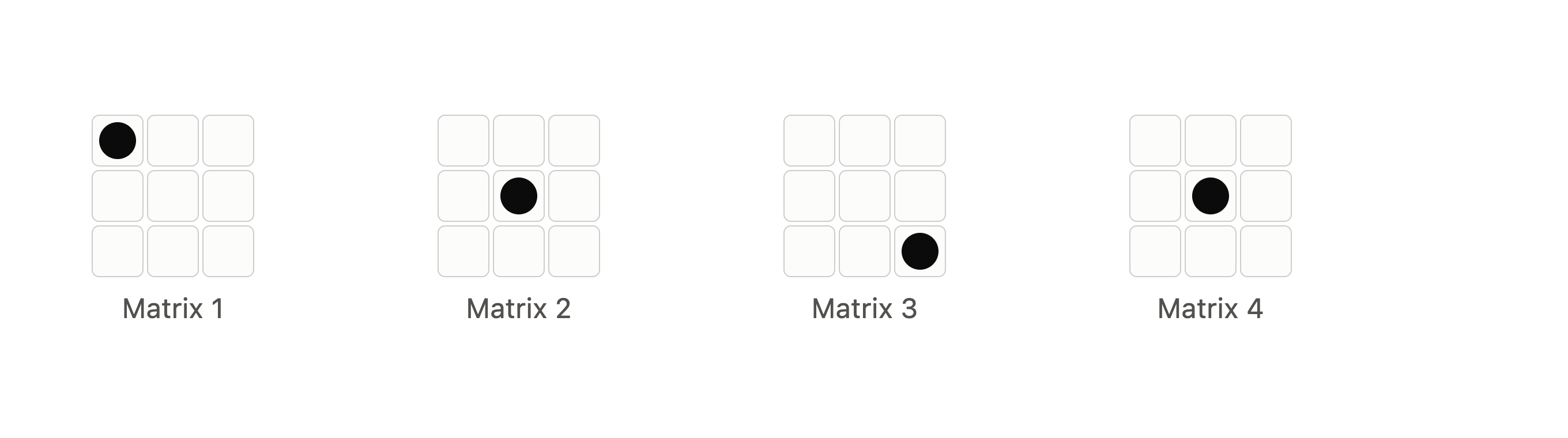
Options for Matrix 5:
A. Circle at top-left
B. Circle at bottom-right
C. Circle at top-right
D. Circle at bottom-left

Answer: A.
The circle moves one step diagonally down-right in each matrix until it hits the bottom-right corner in Matrix 3, then bounces and retraces its path diagonally up-left. Matrix 4 lands back at the centre, so Matrix 5 returns to the top-left starting position.
Sample Question 2
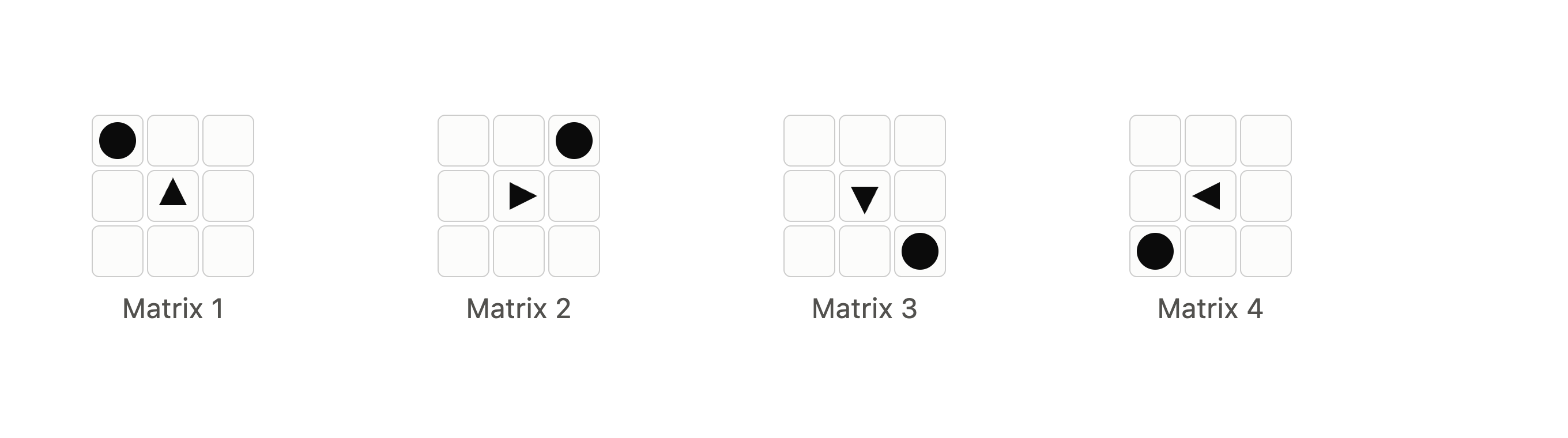
Options for Matrix 5:
A. Circle at top-left, arrow pointing up
B. Circle at top-right, arrow pointing up
C. Circle at top-left, arrow pointing right
D. Circle at bottom-right, arrow pointing down

Answer: A.
The arrow stays in the centre and rotates 90 degrees clockwise in each matrix, completing a full rotation back to pointing up by Matrix 5. The circle moves two positions clockwise around the outer ring each matrix, skipping one cell between each move, and completes a full loop back to the top-left corner by Matrix 5.
Sample Question 3
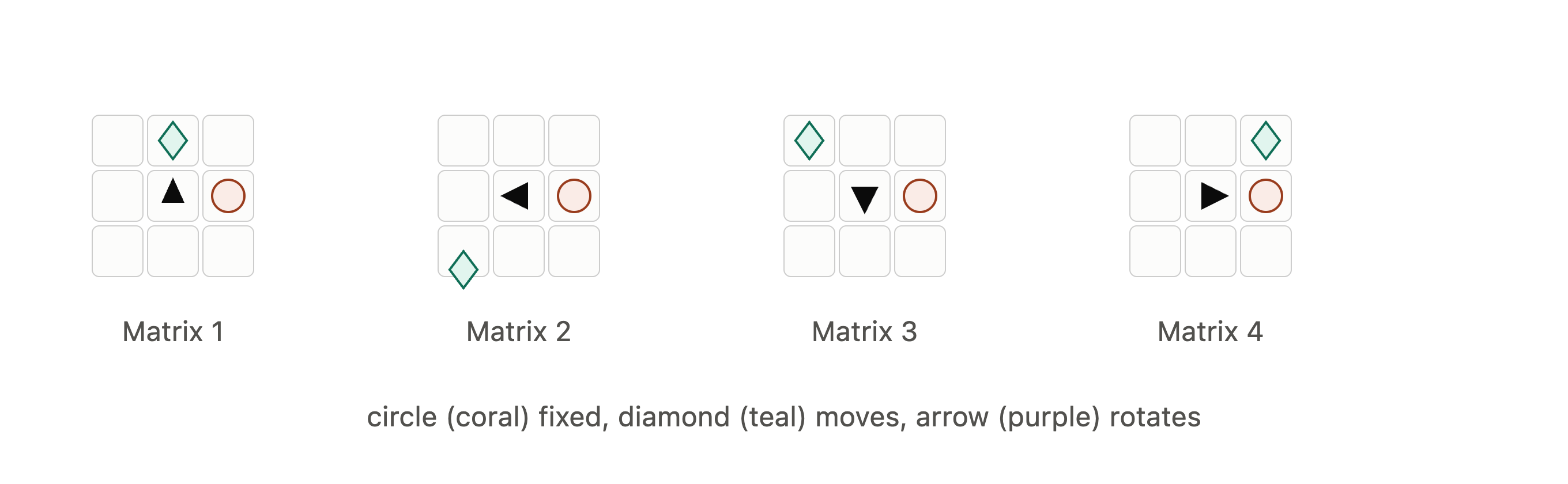
Options for Matrix 5:
A. Circle at bottom-right, diamond at middle-right, arrow pointing right
B. Circle at bottom-left, diamond at middle-right, arrow pointing right
C. Circle at bottom-right, diamond at top-right, arrow pointing left
D. Circle at middle-right, diamond at bottom-right, arrow pointing right

Answer: D.
The circle stays fixed at the middle-right cell throughout; it does not move in any matrix. The diamond moves two positions clockwise around the outer ring each matrix, completing a full loop and returning to the bottom-right position by Matrix 5. The arrow in the centre rotates 90 degrees anticlockwise each matrix, completing a full rotation and returning to pointing right by Matrix 5.
Tips to Solve dMAT Figure Sequences
You get roughly 75 seconds for each dMAT Figure Sequences question. Use that time to identify the pattern systematically rather than testing every answer choice.
- Track one figure at a time: Follow one shape's position, colour, and orientation across all four matrices before moving to another figure.
- State the rule in your head: Describe the pattern in simple terms, such as "moves two steps clockwise", before checking the answer choices.
- Check all four matrices: Make sure your rule works across the complete sequence. If it fails at any stage, reconsider the pattern.
- Predict matrix 5 first: Work out the next figure before looking at the options. Then find the choice that matches your prediction.
- Check colour and orientation last: Confirm the figure's position first, then check its colour and orientation.
- Move on after 75 seconds: If you cannot identify the rule within the available time, make your best guess and continue. With no negative marking, you should attempt every question.
dMAT Figure Sequences 4-Week Study Plan
Build Figure Sequences accuracy through repetition against a timer, not through memorising individual questions, since the exam always generates fresh matrices from the same seven rules. Structure your four weeks around gradually reducing your thinking time until 75 seconds feels comfortable.
Here is a four-week study plan to prepare for dMAT Figure Sequences.
|
Week |
Focus |
What You Practise |
|---|---|---|
|
Week 1 |
Learn the seven rules cold |
Work through untimed low-difficulty questions, one figure and one rule each, until you can name the rule in a single glance |
|
Week 2 |
Add the x+1 progression and boundary movement |
Practise medium-difficulty questions that combine a moving figure with either the x+1 rule or a boundary bounce, still without a strict timer |
|
Week 3 |
Introduce timing and two-figure questions |
Set a 90-second cap per question and move to high-difficulty sequences with two independent figures |
|
Week 4 |
Drill at exam pace with no notes |
Practise strictly at 75 seconds per question, in blocks of 20 questions with no pauses, exactly as the real subtest runs |
From the Desk of Yocket
The dMAT Figure Sequences section rewards a consistent method more than natural visual ability. Since you work within seven known rules, you can improve your score by repeatedly practising how to isolate each figure, identify its rule, and verify that rule across all four matrices until the process becomes quick and automatic.
Yocket Prep gives you structured, timed practice built around the dMAT Module's actual format. This way you can familiarise yourself with the question style, improve your speed, and build confidence before test day.
FAQs on dMAT Figure Sequences
How many Figure Sequences questions are on the dMAT?

Can a figure switch from diagonal to horizontal movement in dMAT Figure Sequences?
Is there negative marking in dMAT Figure Sequences?
Can you take notes during the dMAT Figure Sequences subtest?

Need the Ultimate Study Plan?
Consult with a Master Trainer for a custom roadmap to score high!

 1800-270-6088
'%3e%3cpath%20d='M11.6654%209.60799C11.5056%209.52809%2010.4669%209.04869%2010.3071%208.96879C10.1473%208.88889%209.98752%208.88889%209.82772%209.04869C9.66792%209.20849%209.34832%209.68789%209.18851%209.84769C9.10861%2010.0075%208.94881%2010.0075%208.78901%209.92759C8.22971%209.68789%207.67041%209.36829%207.19101%208.96879C6.79151%208.56929%206.39201%208.08989%206.07241%207.61049C5.99251%207.45069%206.07241%207.29089%206.15231%207.21099C6.23221%207.13109%206.31211%206.97129%206.47191%206.89139C6.55181%206.81149%206.63171%206.65169%206.63171%206.57178C6.71161%206.49188%206.71161%206.33209%206.63171%206.25219C6.55181%206.17229%206.15231%205.21348%205.99251%204.81398C5.91261%204.25468%205.75281%204.25468%205.59301%204.25468H5.19351C5.03371%204.25468%204.79401%204.41448%204.71411%204.49438C4.23471%204.97378%203.99501%205.53308%203.99501%206.17228C4.07491%206.89139%204.31461%207.61049%204.79401%208.24969C5.67291%209.52809%206.79151%2010.5668%208.14981%2011.206C8.54931%2011.3658%208.86891%2011.5256%209.26842%2011.6055C9.66792%2011.7653%2010.0674%2011.7653%2010.5468%2011.6854C11.1061%2011.6055%2011.5855%2011.206%2011.9051%2010.7266C12.0649%2010.407%2012.0649%2010.0874%2011.985%209.76779L11.6654%209.60799ZM13.6629%202.33708C10.5468%20-0.779026%205.51311%20-0.779026%202.397%202.33708C-0.1598%204.89388%20-0.639201%208.80899%201.1186%2011.9251L0%2016L4.23471%2014.8814C5.43321%2015.5206%206.71161%2015.8402%207.99001%2015.8402C12.3845%2015.8402%2015.9001%2012.3246%2015.9001%207.93009C15.98%205.85268%2015.1011%203.85518%2013.6629%202.33708ZM11.5056%2013.5231C10.4669%2014.1623%209.26841%2014.5618%207.99001%2014.5618C6.79151%2014.5618%205.67291%2014.2422%204.63421%2013.6829L4.39451%2013.5231L1.9176%2014.1623L2.5568%2011.7653L2.397%2011.5256C0.479401%208.32959%201.4382%204.33458%204.55431%202.33708C7.67041%200.339576%2011.6654%201.37828%2013.583%204.41448C15.5006%207.53059%2014.6217%2011.6055%2011.5056%2013.5231Z'%20fill='%232B3340'/%3e%3c/g%3e%3cdefs%3e%3cclipPath%20id='clip0_202_11837'%3e%3crect%20width='16'%20height='16'%20fill='white'/%3e%3c/clipPath%3e%3c/defs%3e%3c/svg%3e) +91 6366421078
+91 6366421078 support@yocket.in
 1st floor, Chandermukhi Building, Nariman Point, Mumbai, Maharashtra 400021
© 2026 Yocket Prep. All rights reserved.
GRE® is a registered trademark of Educational Testing Service (ETS). This website is not endorsed or approved by ETS.


